

How Stress Affects Your Physical Health: What Your Body Is Telling You
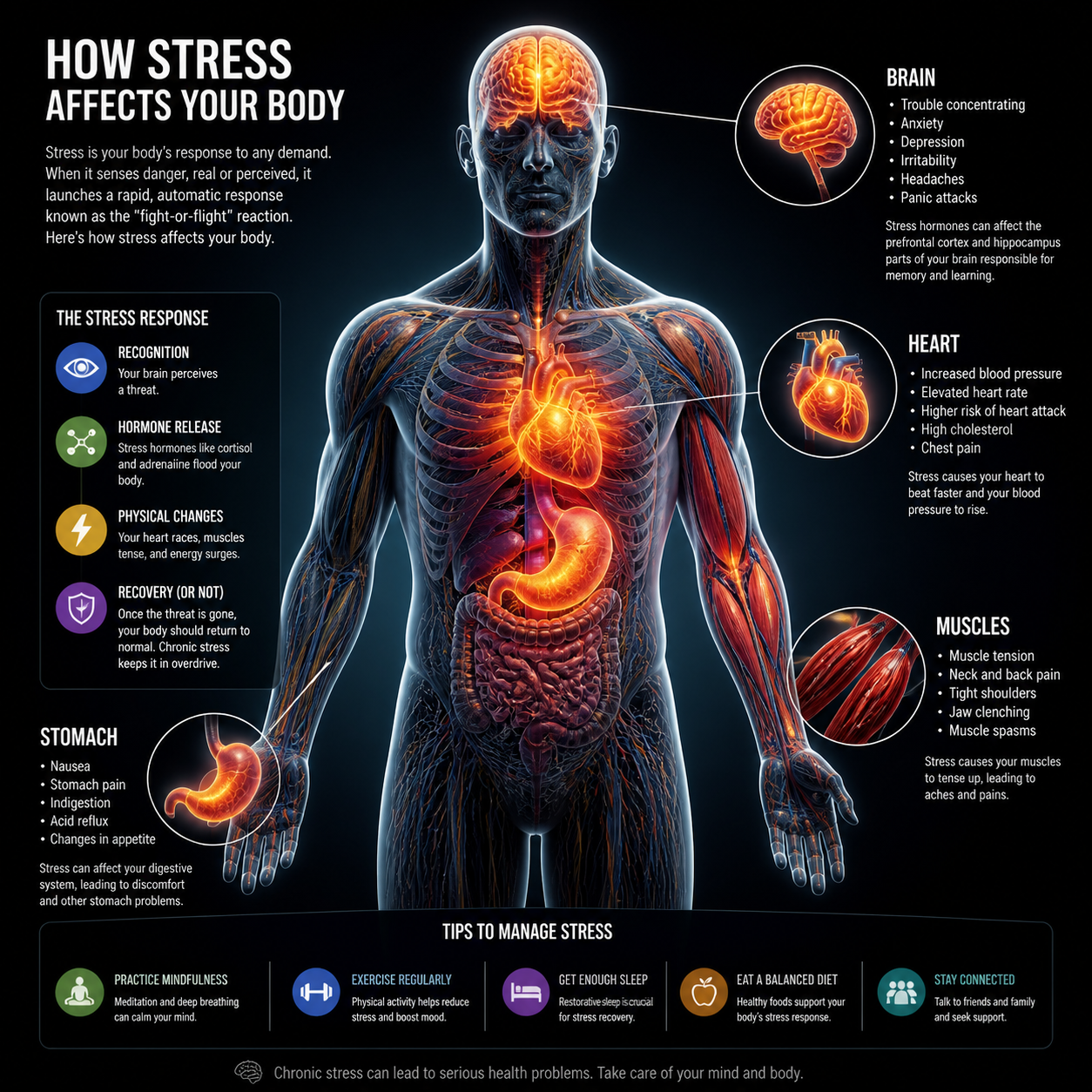
Most people think of stress as a mental burden — anxiety, worry, a racing mind. But your body doesn't make that distinction. When stress hits, it triggers a cascade of physical changes that can damage organs, disrupt systems, and leave measurable marks on your health over time. Understanding exactly what happens — and which symptoms are actually stress in disguise — is the first step toward doing something about it.
What Happens in Your Body When You Feel Stressed
Stress activates a hardwired survival system involving the autonomic nervous system and a surge of hormones, primarily cortisol and adrenaline. Within seconds of perceiving a threat, your body shifts into fight-or-flight mode.
The hypothalamus signals the adrenal glands to release adrenaline, which raises your heart rate and redirects blood to your muscles. Then cortisol — the primary stress hormone — floods your system to sustain that alert state. Blood sugar rises, digestion slows, and immune activity dips. All of this is useful for short-term survival.
The problem is that the human stress response wasn't designed for the modern world. A difficult boss, financial pressure, or chronic illness doesn't resolve in minutes the way a predator encounter might. When the stress response stays switched on for days, weeks, or months, those same survival mechanisms begin to erode the systems they were meant to protect.
Acute stress — a single intense event — typically resolves without lasting damage. Chronic stress is a different matter entirely. Persistently elevated cortisol disrupts nearly every major body system, often in ways that don't announce themselves clearly until the damage is already underway.
The Impact of Stress on Your Heart and Blood Pressure
Chronic stress is a significant contributor to elevated blood pressure and increased cardiovascular risk. During each stress response, the heart beats faster and blood vessels constrict — a pattern that, repeated daily, puts sustained pressure on arterial walls.
Over time, this contributes to hypertension, arterial stiffness, and a higher likelihood of cardiac events. People under prolonged stress also tend to engage in behaviors that compound the risk: disrupted sleep, reduced physical activity, poor diet, and sometimes increased alcohol use.
What makes this particularly tricky is that stress-related cardiovascular symptoms — chest tightness, palpitations, shortness of breath — are often dismissed as anxiety. They can be both. A racing heart during a stressful period may be psychosomatic in origin, but it still places real strain on cardiac tissue. The distinction between "it's just stress" and "this needs evaluation" matters clinically, which is why these symptoms deserve attention rather than reassurance alone.
How Stress Weakens Your Immune System
Chronic stress suppresses immune function by keeping cortisol levels elevated beyond their useful range. Cortisol is naturally anti-inflammatory in short bursts, but sustained high levels interfere with the production and activity of immune cells, particularly lymphocytes.
The practical result: people under long-term stress get sick more often, recover more slowly, and may find that wounds or infections take longer to heal than expected. Research in psychoneuroimmunology — the study of how psychological states affect immune response — has consistently shown that individuals experiencing chronic stress have measurably reduced immune defenses.
This isn't a minor inconvenience. Immune suppression from chronic stress can reactivate dormant viruses like herpes simplex or Epstein-Barr, reduce vaccine effectiveness, and leave the body less equipped to handle new infections. If you find yourself catching every cold that passes through your office, stress may be a contributing factor worth discussing with a clinician.
Stress and Your Digestive Health
The gut is one of the most stress-sensitive organs in the body, largely because of the gut-brain axis — a bidirectional communication network linking the central nervous system to the enteric nervous system that governs digestion.
When stress activates the fight-or-flight response, digestion is deprioritized. Blood flow to the gut decreases, motility changes, and the gut's microbial balance can shift. For some people, this means constipation; for others, it triggers diarrhea or cramping. Nausea before a high-stakes event is the most familiar version of this — but in chronic stress, these disruptions become persistent.
Stress is closely linked to irritable bowel syndrome (IBS), functional dyspepsia, and appetite dysregulation. Some people lose their appetite almost entirely under stress; others turn to food as a coping mechanism, often preferring calorie-dense options that further stress the digestive system.
What's worth knowing: treating digestive symptoms without addressing their stress origin tends to produce incomplete results. If you've cycled through dietary changes and antacids without lasting relief, a comprehensive evaluation that includes stress as a variable is worth pursuing.
Muscle Tension, Headaches, and Physical Pain
Stress causes muscles to contract as part of the fight-or-flight preparation — and in chronic stress, that tension never fully releases. The result is a predictable pattern of musculoskeletal pain that patients frequently attribute to posture, injury, or overuse.
Tension headaches are among the most common stress-related physical complaints. They typically present as a band of pressure around the forehead or back of the skull, driven by sustained contraction in the neck, scalp, and shoulder muscles. Jaw clenching and teeth grinding (bruxism) follow the same mechanism and often occur during sleep, when the person has no conscious awareness of it.
Back and neck pain are also frequent stress markers. The trapezius and paraspinal muscles are particularly prone to holding chronic tension, and patients who present with persistent back pain but no structural cause on imaging are sometimes carrying stress in their musculature rather than their spine.
This doesn't mean the pain is imaginary — psychosomatic symptoms are real, physical, and measurable. It means the treatment approach needs to address the underlying nervous system activation, not just the muscle itself.
Sleep, Fatigue, and the Stress Cycle
Stress and sleep have a mutually destructive relationship. Elevated cortisol in the evening delays sleep onset, reduces deep sleep stages, and increases nighttime wakefulness. Poor sleep, in turn, raises cortisol the following day — making stress harder to manage and physical symptoms more pronounced.
This feedback loop is one of the most clinically significant aspects of chronic stress. A person who is stressed sleeps poorly, wakes up more reactive, handles daily challenges less effectively, and ends the day more stressed than they started. Over weeks, this cycle produces fatigue that doesn't respond to rest, cognitive fog, and a body that feels perpetually worn down.
Fatigue from stress-disrupted sleep is different from ordinary tiredness. It tends to be heaviest in the morning, doesn't improve with an early night, and is often accompanied by difficulty concentrating or emotional flatness. If this pattern sounds familiar, addressing the stress response directly — rather than chasing sleep with supplements or sleep aids alone — is likely to be more effective.
When to See a Doctor About Stress-Related Symptoms
Physical symptoms caused or worsened by stress still warrant medical evaluation — especially when they're new, severe, or persistent. Stress does not rule out other causes, and a clinician's job is to determine what's driving the symptom, not to assume it away.
Seek prompt medical attention for:
- Chest pain or pressure, particularly with shortness of breath or arm discomfort
- Heart palpitations that are frequent, prolonged, or accompanied by dizziness
- Severe or sudden headaches that differ from your usual pattern
- Digestive symptoms that include blood, significant weight loss, or persistent vomiting
- Physical symptoms that are interfering with daily function for more than a few weeks
For symptoms that are clearly stress-related but ongoing, a healthcare provider can offer more than reassurance. Depending on the presentation, options include cognitive behavioral therapy (CBT), which has strong evidence for reducing physical stress symptoms; medication to address specific manifestations like hypertension or sleep disruption; and referral to specialists in integrative or behavioral medicine.
The most important shift is recognizing that stress-related physical illness is a legitimate clinical concern. Telling a doctor that you've been under significant stress and that your body seems to be responding to it is useful clinical information — not a complaint to be minimized.
Frequently Asked Questions
Can stress cause chest pain or shortness of breath?
Yes. Stress activates the autonomic nervous system, which can cause chest tightness, palpitations, and shortness of breath through muscle tension and cardiovascular changes. However, these symptoms overlap with cardiac conditions and should always be evaluated by a doctor to rule out a physical cause.
How long does it take for stress to affect physical health?
Acute stress produces physical effects within minutes. Chronic stress begins to cause measurable changes — in blood pressure, immune function, and digestive health — within weeks to months of sustained exposure. Some effects, like cortisol-related immune suppression, can appear relatively quickly in high-stress periods.
What are the most common physical symptoms of chronic stress?
The most frequently reported physical symptoms include tension headaches, muscle pain (especially neck and back), digestive disturbances, fatigue, frequent illness, and disrupted sleep. Many patients don't connect these symptoms to stress until a pattern becomes clear over time.
Can reducing stress reverse physical damage to the body?
In many cases, yes — particularly for functional changes like elevated blood pressure, digestive disruption, and immune suppression. The body has significant capacity to recover when the stress load is reduced. Structural damage from years of hypertension or chronic inflammation is harder to reverse, which is why early intervention matters.
Is stress-related physical illness taken seriously by doctors?
It should be, and in evidence-based clinical settings it is. The connection between psychological stress and physical health outcomes is well-established in medical literature. If you feel your symptoms are being dismissed, it's reasonable to ask for a more thorough evaluation or seek a second opinion.